
Grade 5 Grammar Worksheet on Using Question Marks

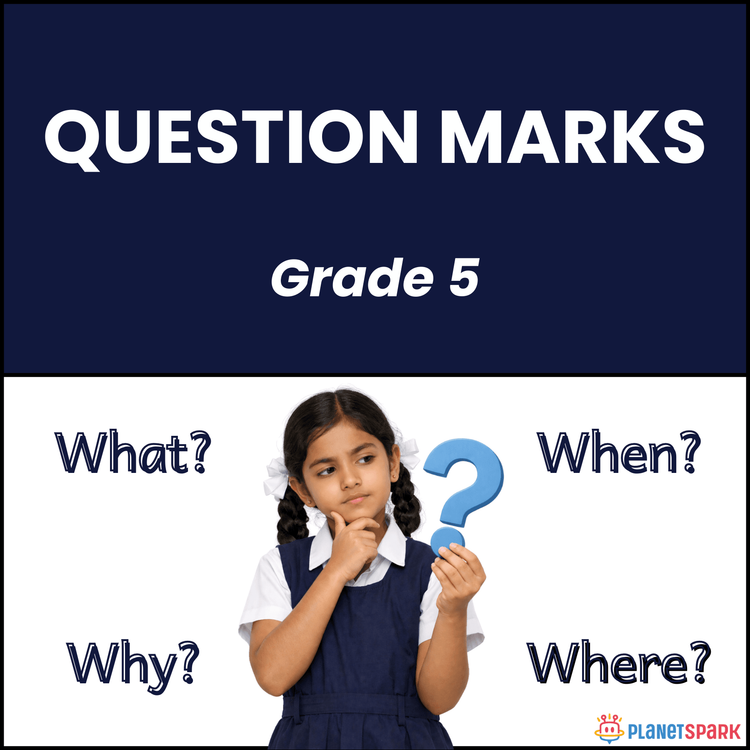
Grade 5 Grammar Worksheet on Using Question Marks
Ask It Right: Question Marks and Question Words for Class 5
This Grade 5 worksheet helps students understand how to use question marks correctly and how to form meaningful questions using appropriate question words. Through a variety of grammar-focused activities, learners practice identifying correct question sentences, spotting punctuation errors, and completing sentences with suitable question words.
Question marks play an important role in written communication. They help readers understand when someone is asking something and guide the tone of the sentence. This worksheet helps young learners build confidence in forming questions and recognizing correct punctuation while reading and writing.
Why Question Marks Matter in Grammar?
Question marks are essential punctuation marks used to show that a sentence is asking something. For Grade 5 learners, mastering this topic is important because:
1. Question marks clearly indicate when a sentence is asking for information.
2. They help structure conversations and written dialogue correctly.
3. They improve reading comprehension by signaling inquiry.
4. They strengthen grammar accuracy in both writing and speaking.
What’s Inside This Worksheet?
This worksheet includes five engaging grammar exercises that help students practice using question marks and question words effectively.
Exercise 1 – Choose the Correct Question Sentence
Students identify the sentence that correctly forms a question and uses the question mark properly. This activity helps learners recognize the difference between statements and questions.
Exercise 2 – True or False: Correct Question Marks
Students read each sentence and determine whether the question mark or punctuation is used correctly. They mark True for correct punctuation and False for incorrect punctuation.
Exercise 3 – Fill in the Blanks with Question Words
Learners complete each sentence using suitable question words such as *who, where, why, when,* and *what*. This exercise strengthens understanding of how questions are formed.
Exercise 4 – Replace the Reporting Verb
Students replace the word *said* or *told* with a more suitable word from a word bank such as *questioned, politely, curiously,* or *directly*. This improves vocabulary and sentence clarity.
Exercise 5 – Paragraph Completion with Question Words
Students read a short passage and fill in blanks with appropriate words such as *when, where, if,* or *who*. This task builds comprehension and grammar skills through contextual learning.
Answer Key (For Parents & Educators)
Exercise 1 – Multiple Choice
1. c
2. c
3. b
4. a
5. a
6. b
7. a
8. c
9. a
10. b
Exercise 2 – True or False
1. True
2. True
3. False
4. False
5. False
6. False
7. False
8. True
9. True
10. True
Exercise 3 – Fill in the Blanks
1. Who
2. Where
3. Why
4. Where
5. When
6. Why
7. What
8. What
9. Why
10. When
Exercise 4 – Replace One Word Using the Word Box
1. Tina inquired where are you going.
2. Amit questioned where is my pencil.
3. Meera politely said what is your name.
4. Asha directly told why are you late.
5. Raj directly said when will the bus come.
6. The teacher inquiring told where is your book.
7. The guard questioned who are you.
8. Mother curiously told why is the door open.
9. Rohit directly said where did you go.
10. The coach politely told when will practice start.
Exercise 5 – Passage Completion
1. when
2. where
3. if
4. where
5. if
6. when
7. if
8. when
9. if
10. if
11. when
12. when
13. if
14. who
15. why
Strengthen your child’s punctuation and questioning skills with interactive grammar learning through PlanetSpark’s expert-led English communication classes.
Frequently Asked Questions
A question mark is placed at the end of a sentence that asks something. In Class 5 grammar worksheets, students learn to identify question sentences and end them correctly with a question mark.
Students sometimes treat all sentences the same and forget that questions require a question mark. Grammar worksheets help them recognize question words like who, what, where, when, why, and how.
A grammar worksheet gives learners practice identifying question sentences, rewriting statements as questions, and placing the correct punctuation mark, which strengthens CBSE English writing skills.