
Class 5 Homophones Your You’re Their There Worksheet

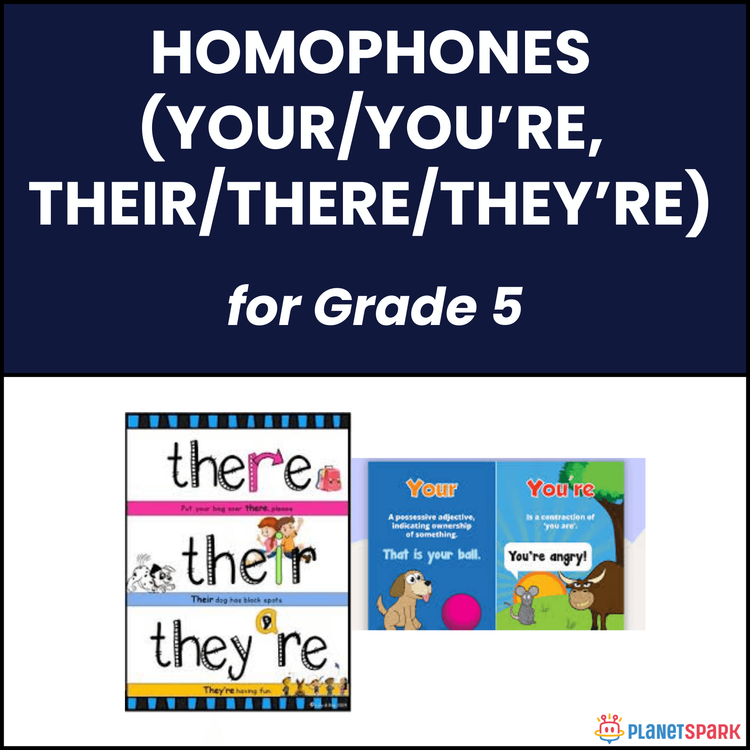
Class 5 Homophones Your You’re Their There Worksheet
Choose the Right Word: Mastering Your, You’re, Their, There, and They’re for Class 5
This Grade 5 grammar worksheet focuses on understanding and correctly using common homophones: your / you’re and their / there / they’re. These words sound the same but have different meanings and spellings, which often causes confusion for young learners. Through structured and engaging exercises, students learn to identify the correct homophone based on sentence context.
This worksheet helps learners strengthen their grammar accuracy and sentence comprehension while developing careful reading and writing skills. By practicing with meaningful examples and everyday situations, students become more confident in using homophones correctly in both spoken and written English.
Why Homophones Matter in Grammar?
Homophones are words that sound the same but have different meanings and spellings. Understanding them is an essential grammar skill for Grade 5 learners because:
1. They improve writing accuracy and prevent common spelling mistakes.
2. They help students understand how context determines meaning in sentences.
3. They build stronger reading comprehension and vocabulary awareness.
4. They support clearer communication in both school assignments and everyday writing.
What’s Inside This Worksheet?
This worksheet includes five engaging grammar activities designed to help students recognize and use homophones correctly.
Exercise 1 – True or False
Students read statements about the meanings and uses of homophones such as your, you’re, their, there, and they’re. They identify whether each statement is true or false and correct any incorrect information.
Exercise 2 – Sort the Words
Students classify word pairs into two categories: Homophones and Not Homophones. This activity strengthens their understanding of words that sound alike but have different meanings.
Exercise 3 – Fill in the Blanks
Students choose the correct homophone from a pair such as your/you’re or their/there to complete each sentence correctly based on context.
Exercise 4 – Multiple Choice Questions
Learners select the correct homophone from four options to complete sentences accurately.
Exercise 5 – Sentence Rewriting
Students rewrite sentences by correcting incorrectly used homophones, reinforcing their understanding through editing and grammar correction.
Answer Key (For Parents & Educators)
Exercise 1 – True or False
1. True
2. False
3. True
4. True
5. True
6. False
7. True
8. False
9. True
10. False
Exercise 2 – Sort the Words
Homophones
see/sea
right/write
your/you’re
their/there
they’re/there
sun/son
flour/flower
one/won
Not Homophones
tree/free
cat/dog
milk
book/back
chair/table
bus/car
pen/pencil
Exercise 3 – Fill in the Blanks
1. Your
2. you’re
3. their
4. there
5. they’re
6. your
7. their
8. they’re
9. there
10. your
Exercise 4 – Multiple Choice
1. b) you’re
2. a) their
3. c) there
4. b) you’re
5. b) their
6. d) their
7. c) they’re
8. d) their
9. b) you’re
10. a) their
Exercise 5 – Corrected Sentences
1. Riya forgot your notebook at home.
2. The children left their bags outside.
3. Asha said you’re coming to the match.
4. They’re going to the school fair today.
5. Ravi kept their shoes near the door.
6. Meera said they’re ready for class.
7. The students forgot their homework.
8. They’re playing cricket after school.
9. You’re going to the assembly today.
10. Raj said you’re late for class.
Help your child avoid common grammar mistakes and build strong writing skills with guided homophone practice and expert-led communication classes from PlanetSpark.
Frequently Asked Questions
Your shows possession, while you're is a contraction of you are. Understanding this difference helps students avoid common mistakes in Class 5 English grammar writing.
Their shows possession for people, while there refers to a place or position. Practicing with a Class 5 homophones worksheet helps children learn the correct usage through sentence examples.
Homophones sound the same but have different meanings and spellings, so learning them helps students improve spelling accuracy and sentence clarity in CBSE English writing.