
Class 5 Word Formation Adjective and Adverb Worksheet

Class 5 Word Formation Adjective and Adverb Worksheet
From Adjective to Adverb: Building Better Sentences in Class 5
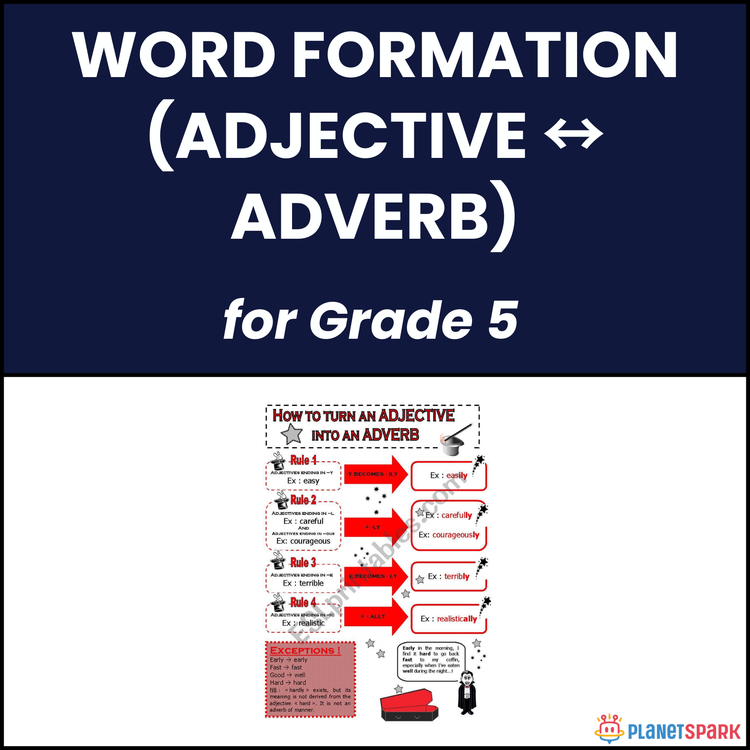
This Grade 5 grammar worksheet focuses on Word Formation (Adjective ↔ Adverb) and helps students understand how adjectives change into adverbs to describe actions more clearly. Adjectives describe nouns, while adverbs describe verbs and explain how an action happens. Learning this difference helps children write clearer and more expressive sentences.
Through engaging activities such as true or false, sorting word pairs, fill-in-the-blanks, multiple-choice questions, and sentence rewriting, students practice identifying the correct form of words like quick/quickly, soft/softly, and bright/brightly. These exercises strengthen grammar accuracy while helping learners notice how word endings such as –ly change meaning and function in a sentence.
Why Word Formation (Adjective ↔ Adverb) Matters in Grammar?
Understanding how adjectives and adverbs work is an important grammar skill for Grade 5 learners because:
1. Adjectives describe nouns, while adverbs describe verbs or actions.
2. Many adverbs are formed by adding –ly to adjectives (quick → quickly).
3. Using the correct form improves sentence clarity and meaning.
4. It helps students write richer, more descriptive sentences in stories and assignments.
What’s Inside This Worksheet?
This worksheet contains five structured activities designed to help students recognize and correctly use adjective and adverb forms.
Exercise 1 – True or False
Students read statements about adjectives and adverbs and decide whether they are correct. If a statement is incorrect, students identify the error and correct it.
Exercise 2 – Sort the Words
Students sort word pairs such as happy/happily and quick/quickly into two categories: Adjective and Adverb.
Exercise 3 – Fill in the Blanks
Students choose the correct adjective or adverb to complete sentences based on how the word functions in the sentence.
Exercise 4 – Multiple Choice Questions
Students select the correct word form from four options to complete each sentence correctly.
Exercise 5 – Sentence Rewriting
Students rewrite sentences by correcting incorrectly used adjectives or adverbs, strengthening their editing and grammar awareness.
Answer Key (For Parents & Educators)
Exercise 1 – True or False
1. True
2. True
3. True
4. True
5. False
6. True
7. True
8. False
9. True
10. True
Exercise 2 – Sort the Words
Adjective
happy
loud
soft
sudden
kind
neat
bright
safe
quick
slow
clear
careful
brave
calm
honest
Adverb
happily
loudly
softly
suddenly
kindly
neatly
brightly
safely
quickly
slowly
clearly
carefully
bravely
calmly
honestly
Exercise 3 – Fill in the Blanks
1. loudly
2. quickly
3. softly
4. clearly
5. slowly
6. neatly
7. easily
8. clearly
9. strongly
10. brightly
Exercise 4 – Multiple Choice
1. b) quickly
2. d) clearly
3. a) correctly
4. c) slowly
5. c) carefully
6. a) neatly
7. c) beautifully
8. c) politely
9. c) quickly
10. b) calmly
Exercise 5 – Corrected Sentences
1. Riya sang loudly in assembly today.
2. The baby slept softly during the nap.
3. Asha spoke clearly in the meeting.
4. Ravi solved the sum quickly in class.
5. The bus moved slowly in traffic today.
6. Meera wrote neatly in her notebook.
7. The teacher explained clearly in class.
8. The lamp shone brightly in the room.
9. Raj finished the work quickly yesterday.
10. The wind blew strongly during rain.
Help your child improve sentence clarity and descriptive writing by mastering adjectives and adverbs through guided grammar practice with PlanetSpark experts.
Frequently Asked Questions
An adjective describes a noun, while an adverb describes a verb, adjective, or another adverb. Learning this difference helps Class 5 students build clearer and more descriptive sentences.
Many adverbs end with “-ly” and explain how an action happens, such as quickly, slowly, or happily. Practicing with a Class 5 adjective and adverb worksheet helps children recognize these patterns easily.
Understanding how adjectives change into adverbs helps students improve sentence detail, grammar accuracy, and vocabulary skills in CBSE English writing.