
Class 4 English Worksheet: Homophones and Homonyms

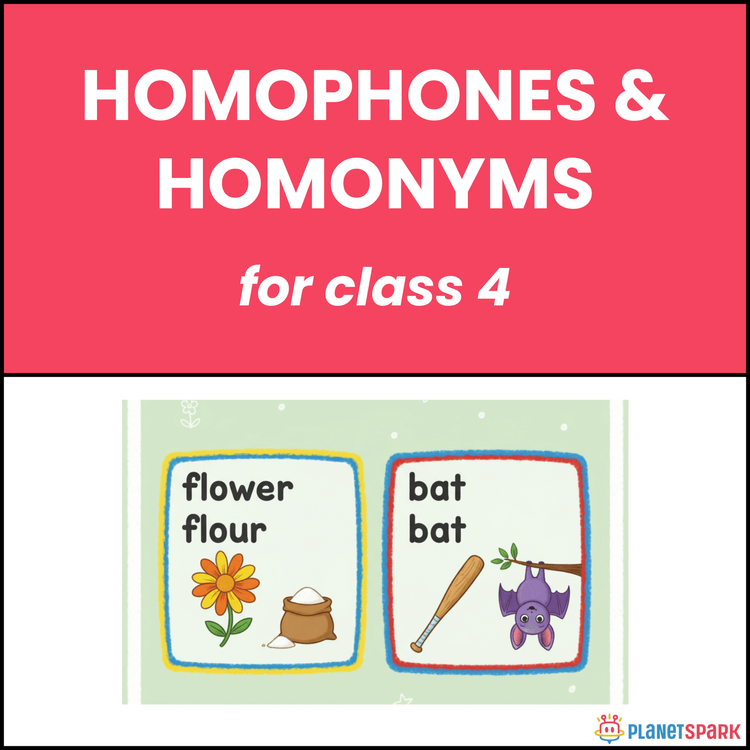
Class 4 English Worksheet: Homophones and Homonyms
Sound Sense: Grammar Worksheet “Homophones and Homonyms” for Class 4
This Grade 4 grammar worksheet helps learners master **homophones (words that sound alike but have different meanings and spellings)** and **homonyms (words with the same spelling or pronunciation but different meanings)** through fun and challenging exercises. Students strengthen spelling, vocabulary, and comprehension with practical examples and creative language tasks.
Why Homophones and Homonyms Matter in Grammar?
Understanding sound-alike and look-alike words helps children:
1. Use the correct word meaning in the right context.
2. Improve spelling and reading comprehension.
3. Avoid confusion while writing.
4. Develop critical thinking and attention to language details.
What’s Inside This Worksheet?
The worksheet includes five exciting exercises designed to make learning interactive:
🧠 **Exercise 1 – Match the Following**
Students match words with their correct homophones (e.g., *sea–see, blue–blew, flower–flour, hole–whole*).
✏️ **Exercise 2 – Sort the Words**
Learners classify given pairs into *homophones* (e.g., *peace/piece, right/write*) and *homonyms* (e.g., *bark/bark, fair/fair*).
📋 **Exercise 3 – Fill in the Blanks**
Students use the correct homonym to complete sentences based on clues:
Example: “Rahul hit the ball with a *bat*, and a *bat* flew out.”
📝 **Exercise 4 – Multiple Choice Questions**
Children choose the correct homophone for an underlined word. Example:
“She went to the *sea* to ______ the waves.” → ✅ *see*
✍️ **Exercise 5 – Sentence Rewriting**
Students rewrite sentences with the correct homonyms:
Example: “She will *led* the class with a heavy *lead*.” → “She will *lead* the class with a heavy *lead*.”
✅ **Answer Key (For Parents & Educators)**
**Exercise 1 – Match the Following:**
see–sea, blue–blew, one–won, right–write, dear–deer, flour–flower, peace–piece, hole–whole, tail–tale, night–knight
**Exercise 2 – Sort the Words:**
*Homophones:* dear/deer, peace/piece, one/won, flour/flower, right/write, road/rode
*Homonyms:* bark/bark, can/can, fair/fair, park/park, lead/lead
**Exercise 3 – Fill in the Blanks:**
1. bat 2. lead 3. bank 4. ring 5. bark 6. well 7. watch 8. storey 9. knight 10. pen
**Exercise 4 – Choose the Correct Homophone:**
1. b) see 2. d) blew 3. a) one 4. b) write 5. d) flour 6. b) deer 7. c) piece 8. b) tale 9. d) hole 10. c) knight
**Exercise 5 – Rewrite Each Sentence Using the Correct Homonym:**
1. The *bat* flew away.
2. He went to the *bank*.
3. The gold *ring* shone as the bell *rang*.
4. She will *lead* the class with a heavy *lead*.
5. The dog’s *bark* frightened the monkeys on the bark.
6. He was *well* and drank from the *well*.
7. He wrote with a *pen* in his animal *pen*.
8. The tall *tale* was told in the high *storey*.
9. She used a *glass* to *watch* the play.
10. The brave *knight* fought in the dark *night*.
Make grammar fun and practical with this Class 4 homophones and homonyms worksheet — perfect for building accuracy, logic, and word confidence!
Frequently Asked Questions
Homophones sound the same but differ in meaning, homonyms share spelling or pronunciation with multiple meanings.
Because both involve sound or spelling similarities that can confuse meaning.
They provide clear examples so children can practice correct word use in context.