
Class 6 English Worksheet on Participle Adjectives

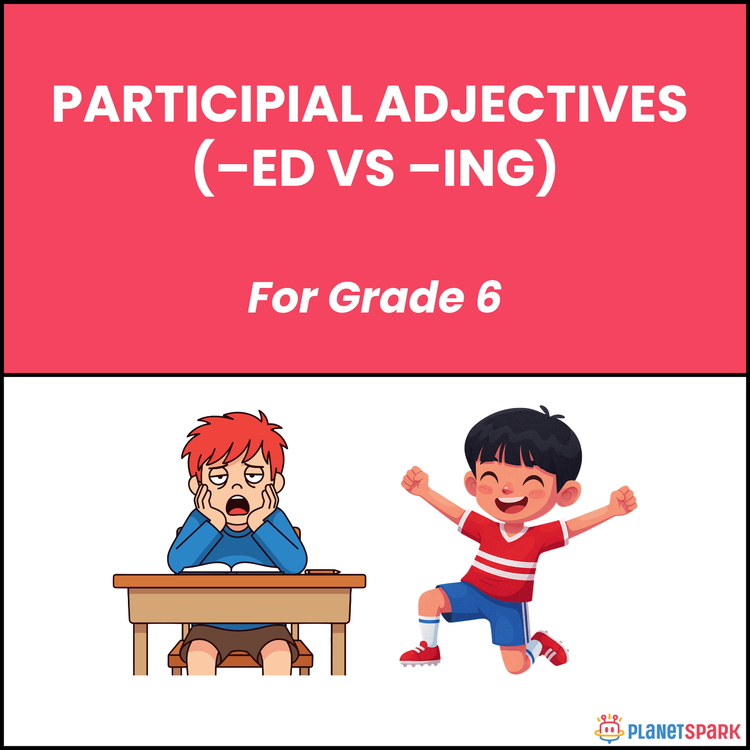
Class 6 English Worksheet on Participle Adjectives
Feel It or Describe It: Participle Adjectives for Class 6
This Grade 6 English worksheet focuses on helping students understand and correctly use participial adjectives, especially the difference between –ed and –ing forms. It helps learners recognize how adjectives can describe feelings (–ed) or causes of feelings (–ing), making their sentences clearer and more expressive.
Why Participle Adjectives Matter in Grammar?
Participle adjectives help students express emotions and descriptions more accurately. For Grade 6 learners, this topic is important because:
1. It helps distinguish between feelings (e.g., bored) and causes (e.g., boring).
2. It improves sentence clarity and correctness.
3. It prevents common grammar mistakes in writing and speaking.
4. It enhances descriptive and expressive language skills.
What’s Inside This Worksheet?
This worksheet includes five grammar-rich activities that build mastery in participial adjectives:
🧠 Exercise 1 – Multiple Choice Questions
Students choose the correct –ed or –ing adjective form to complete each sentence.
✏️ Exercise 2 – Fill in the Blanks
Students select the correct participial adjective from given pairs to complete sentences accurately.
📋 Exercise 3 – True or False
Students identify whether the participial adjective used in each sentence is correct.
📝 Exercise 4 – Underline the Incorrect Adjective
Students find and underline incorrectly used participial adjectives, improving error correction skills.
✍️ Exercise 5 – Paragraph Completion
Students fill in blanks with suitable participial adjectives, applying their understanding in context.
✅ Answer Key (For Parents & Educators)
Exercise 1 – Multiple Choice Answers
1. b) boring
2. a) confused
3. a) tired
4. b) surprising
5. b) exciting
6. a) amazed
7. a) bored
8. a) frightened
9. a) amused
10. a) embarrassed
Exercise 2 – Fill in the Blanks
1. boring
2. exciting
3. tired
4. amused
5. surprising
6. embarrassed
7. confusing
8. amused
9. exciting
10. frightened
Exercise 3 – True or False
1. True
2. True
3. True
4. False
5. True
6. True
7. False
8. True
9. False
10. True
Exercise 4 – Incorrect Adjectives
1. boring
2. no error
3. amusing
4. no error
5. confusing
6. boring
7. amusing
8. embarrassing
9. no error
10. amusing
Exercise 5 – Paragraph Completion (Sample Answer)
The forest was an exciting place, full of mysterious sounds and moving shadows.
The trees were swaying in the wind, and the leaves made a rustling sound as they fell.
We were all feeling a little frightened by the eerie atmosphere, but the guide was reassuring as she led us through the forest.
We came across a stunning waterfall that looked both amazing and breathtaking.
The experience left us feeling amazed but happy to have witnessed the beauty of nature.
Help your child master –ed and –ing adjectives and express feelings and descriptions with clarity and confidence.
🔖Book a free trial!
Frequently Asked Questions
Participle adjectives are formed from verbs and describe the effect something has (e.g., "excited," "bored").
Regular adjectives describe characteristics, while participle adjectives describe feelings caused by an action.
When describing emotions or states caused by an event, such as "The movie was thrilling."