
Class 6 Grammar Worksheet on Infinitives To Verb

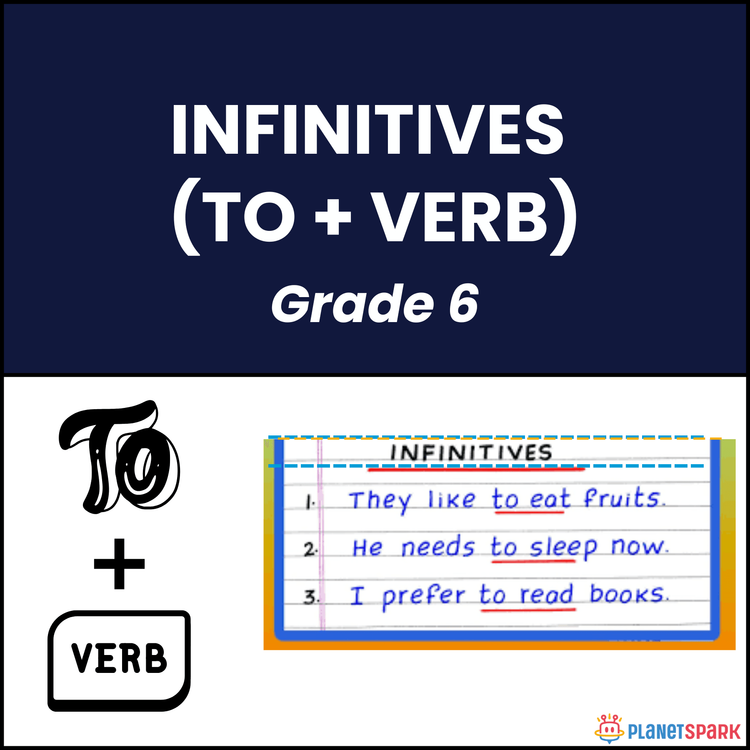
Class 6 Grammar Worksheet on Infinitives To Verb
Master the Base: Infinitives (To + Verb) for Class 6
This Grade 6 English grammar worksheet provides a structured approach to understanding and using infinitives (To + Verb). Through a variety of engaging exercises, students will learn how to identify these non-finite verb forms and use them effectively in different sentence structures. This resource focuses on building fluency by moving from simple identification to complex sentence rewriting where the infinitive serves as the subject.
Why Infinitives Matter in Grammar?
Infinitives are essential tools for expanding a student's expressive range. For Grade 6 learners, this topic is important because:
1. They allow students to express purpose, intent, and necessity clearly.
2. They function as versatile building blocks that can act as subjects or follow main verbs.
3. They help transition from simple sentences to more sophisticated academic writing.
4. Mastering them is a key step in understanding non-finite verbs, alongside gerunds and participles.
What’s Inside This Worksheet?
This worksheet includes five grammar-rich activities that build fluency with infinitives:
Exercise 1 – Choose the Correct Form
Students select the grammatically accurate sentence or form using the "to + verb" structure. Example: “She loves to swim in the pool.”
Exercise 2 – True and False
Learners evaluate sentences to determine if the infinitive has been applied correctly or incorrectly. Example: “I enjoy to read books before bed.” (False)
Exercise 3 – Fill in the Blanks
Students apply the correct infinitive form of a given verb to complete a sentence logically. Example: “I want to learn to speak Spanish.”
Exercise 4 – Rewrite with Infinitives as Subjects
This advanced task requires students to transform sentences starting with gerunds into sentences using infinitives as the subject. Example: “Exercising regularly...” → “To exercise regularly is essential...”
Exercise 5 – Paragraph Completion
A contextual exercise where students fill in multiple blanks within a paragraph using the correct infinitive forms to maintain flow and meaning.
Complete Answer Key
Exercise No. 1 (Infinitive Choice)
1. b) She loves to swim in the pool.
2. a) I will love to read books.
3. b) I want to go home.
4. a) I need to study for the test.
5. b) She asked to sing at the concert.
6. b) They will learn to swim in the summer.
7. a) I am ready to leave now.
8. b) She is going to cook dinner.
9. a) He wants to learn how to play the guitar.
10. b) She decided to join the gym.
Exercise No. 2 (True/False)
1. True
2. False
3. True
4. True
5. True
6. True (Incorrectly used as stated in task)
7. True
8. False
9. True
10. True
Exercise No. 3 (Fill in the Blanks)
1. to play
2. to learn
3. to dance (Note: worksheet asks for infinitive form)
4. to travel
5. to start
6. to help
7. to study
8. to forget (to bring)
9. to take
10. to read
Exercise No. 4 (Sentence Rewriting)
1. To exercise regularly is essential for maintaining health.
2. To learn a new language opens many doors in life.
3. To read books regularly improves vocabulary and knowledge.
4. To go to the gym daily builds strength and endurance.
5. To help others creates a positive impact on society.
6. To travel abroad offers unforgettable experiences.
7. To take breaks during work increases productivity.
8. To eat healthy foods is important for a balanced diet.
9. To write essays enhances writing skills and clarity.
10. To save money for the future ensures financial stability.
Exercise No. 5 (Paragraph Completion)
It is important to exercise regularly to stay healthy. Many people like to run in the morning as it helps to improve their stamina. Some prefer to swim in the pool, while others choose to take long walks in the park. To maintain a good balance, it is necessary to eat healthy foods. Many people aim to sleep for at least eight hours a night to feel well-rested. It is essential to drink enough water throughout the day. It is also helpful to stretch before exercising to prevent injuries. People often try to follow a workout routine to stay consistent. To enhance results, it is important to track progress regularly.
Equip your child with the tools to write sophisticated and clear sentences by mastering infinitives today.
Frequently Asked Questions
Infinitives are the base form of a verb preceded by "to," like "to read" or "to eat."
Infinitives can be used as subjects, objects, or after certain verbs, e.g., "I like to swim."
Yes, infinitives often follow adjectives to express purpose, such as "She is happy to help."