
Class KG Alphabet Worksheet on Matching Uppercase Letters

Class KG Alphabet Worksheet on Matching Uppercase Letters
Capital Letter Champs: Match Uppercase Letters to Animals for Grade KG
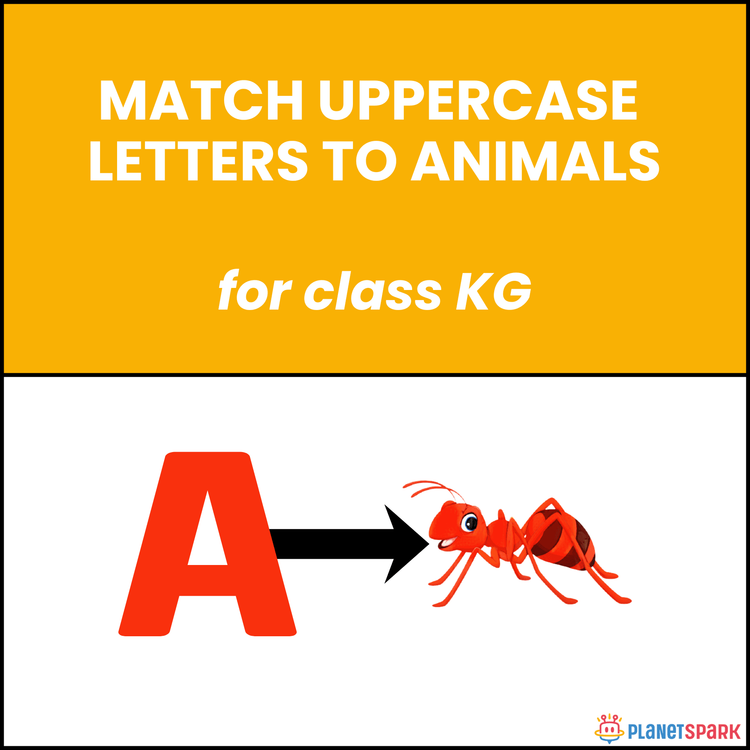
This Grade KG alphabet worksheet on Matching Uppercase Letters to Animals helps young learners strengthen their capital letter recognition through engaging animal-based activities. By connecting uppercase letters with familiar animal names, children build strong alphabet awareness in a fun and meaningful way.
Designed especially for Kindergarten students, this worksheet includes multiple choice questions, fill in the blanks, true or false statements, and picture-based matching activities. Learners practise identifying animals that begin with specific uppercase letters such as E for Elephant, B for Bear, G for Goat, D for Dog, I for Iguana, and many more. These structured activities help children confidently recognise capital letters and associate them with beginning sounds.
Why Uppercase Letter Recognition Matters in Early Literacy?
Understanding uppercase letters is important because:
1. It builds strong alphabet foundations.
2. It improves beginning sound recognition.
3. It prepares children for reading simple words.
4. It strengthens visual memory and letter identification skills.
What’s Inside This Worksheet?
🧠 Exercise 1 – Multiple Choice Questions
Students choose the correct animal that starts with the given uppercase letter (E, B, G, D, I, L, A, F, C, H).
✏️ Exercise 2 – Fill in the Blanks
Learners write the starting uppercase letter for animals like Tiger, Cow, Panda, Owl, Monkey, Seal, Zebra, Duck, Rabbit, and Jellyfish.
📋 Exercise 3 – True or False
Students read statements such as “Yak starts with Y” and identify whether they are True or False.
🖍️ Exercise 4 – Circle the Correct Animal
Children look at pictures and circle the animal that matches the given uppercase letter (B, K, M, S, T, P, H, R, L).
✅ Answer Key (For Parents & Educators)
Exercise 1 – Multiple Choice
1. Elephant
2. Bear
3. Goat
4. Dog
5. Iguana
6. Lion
7. Ant
8. Fish
9. Cat
10. Hen
Exercise 2 – Fill in the Blanks
1. T
2. C
3. P
4. O
5. M
6. S
7. Z
8. D
9. R
10. J
Exercise 3 – True or False
1. True
2. True
3. False
4. True
5. False
6. False
7. False
8. True
9. False
10. True
Exercise 4 – Circle the Correct Animal
B – Butterfly
K – Kangaroo
M – Mouse
S – Sheep
T – Turtle
P – Penguin
H – Hen
R – Rhinoceros
L – Leopard
This worksheet builds strong alphabet recognition skills and prepares children for confident early reading success.
Strengthen your child’s letter-sound foundation with expert-designed uppercase matching practice.
Frequently Asked Questions
It strengthens capital letter recognition and helps children connect letters with beginning sounds through familiar animal names.
The activities build letter-sound association, visual memory, and phonemic awareness, which are essential for early reading development.
Yes, the structured multiple-choice, fill-in-the-blank, and picture-based activities make it ideal for both classroom and at-home learning.